On the morning of the 9th May 1982, we departed from Gutersloh to join the Falkland’s war, and this is my story.
A night in the pub
It is the 9th May, and I am far from home travelling in Asia (serious hard work I promise) and was avoiding human contact as much as possible this evening as I reflect on that particular journey of my life. Around 8 pm, I end up in a Chinese owned, Filipino themed, Thai run, English style pub-like restaurant. Something anyone who has ventured beyond Malaga might comprehend. As I ignored the world, I ate my bunless burger and drank my Chilean Merlot (well sophisticated) a German couple sat down at the next table.
Now for the funny bit: Herman, the German, speaks as much English as I speak Swahili and he wants a bunless burger just like mine and a beer for him and a chicken something and a glass of white wine for Hildegard ( I’m not BSing you) his wife. Now as an Englishman well versed in international travel, I know what he wanted, but to Romana the Tai-speaking Filipino waitress his request got lost in translation. Against my very conservative English persona and better judgement I, who speaks fluent Strasse Deutsche (that’s German with a John Cleese style of speaking slowly and LOUDLY), intervened enough to give them something edible to eat and drink. For Hildegard, any form of sausage, (game bird) and Chardonnay seemed to fit the bill, and by 11 pm she was, shall we say, loose around the trussocks! Herman meanwhile thought that the Chinese Tsingtao beer was like drinking Wobblylite– I appreciate that at this stage I should have exercised parental responsibility, but I was in my annual reflective period.
My reflective period
On the 12th May 1982, I found out that my dad had not been entirely honest with me. When the railway workshops closed in Swindon, I also lost my offer of an apprenticeship. With 5,000 people starting to look for work on the following Monday morning, his advice was to join the RAF because “they send the officers to war”. Little did I know that my dad was not well versed in the ways of the modern RAF world and that erks, like me, were also sent to war. I was on a container ship, sharing a Portakabin welded to the rear flight deck, next to the phosphorous grenade ammunition store with 11 others and heading for sod them until tomorrow (aka the Falklands). As we made “best possible speed past Ascension Island, where everybody else seemed to be taking a very extended, senior officers only, vacation. We went from cruising, very rapidly towards a bruising in the blink of an eye. But more of that later.
Tonight I had Herman and his wife on the next table, their son is working in China, and he came out (i.e., travelled, not announced his new sexuality) a year ago on a 3-month project that is a year behind schedule and they haven’t seen Herman junior for a year. So they sold their caravan (That’s real German for so deadly serious) to come out to Asia to visit Hermann junior in China, and they ended up in the same bar as me by pure accident, or the same mad taxi driver (really another story)
So it’s 11 pm, and Herman and Hildegard have time for one more Apfel schnapps drink (for the untraveled that’s the equivalent of at least a litre of wicked and evil full-on German wheat beer or the equivalent) before leaving for the airport. When just at the moment you know you should go, three Koreans come into the bar. Dad, his son and his son’s very new wife sit on the table on the other side of me. An Englishman’s nightmare; Germans to the left and Koreans to the right and I am suddenly (red wine speed factor 3) surrounded by Johnny Foreigners and worse; I find myself drawn, inexplicitly towards having to talk to them! Meanwhile in their best Korean, Filipino, Thai style English, with a thick Filipino twang, they order burgers and chips and the best £400 a bottle red wine in the bar and for everyone, All six of us. Dad has retired from 30 years of working for a Korean company in China, and he is “plsed to go hom to my wif and great kids”. As you realise Dad speaks English as well as I speak outer Mongolian or Dutch, he is speaking English, badly, and is asking for Johnny Walker Cognac when he really means whisky. £2000 later they and me to a slightly lesser extent are so well lubricated, enough to resist all borders, that I decide that this FART needs to regroup (Penguin Rocks never retreat) to the comfort of my hotel room and get acquainted with my long lost friend Hughie!
What would normally be a reflective 9th May evening thinking back to driving an MK ORV with Mick the creases (somebody had to) Cundy as “shotgun” from Gutersloh to Plymouth via Dover and Odiham had, in fact, turned into an alcohol-infused welcoming and bazaar evening. Shared joy with a bunch of lubricated Johnny foreigners halfway around the world and I felt so empowered I think I should have bought a lottery ticket, or appreciate the cultural bonanza, but here is my story.
The Rhythm Changes
Everything in life has a rhythm whether it is the family, work or the country and it is the changes in the normal rhythm that cause observers to spot the change and analysts to make sense of the differences.
There is a telephone in the Engineering section that more often than not only rings for guys when their wives want them to pick up some shopping on their way home. Occasionally the Eng Boss will ring down, but nobody from the “outside” ever uses the phone. On the Wednesday morning when we get a call from the station MT officer asking about our vehicle status. The call was directed to our MT Sergeant, but it was the first change in the rhythm. After lunch Wing headquarters called asking about the state of our fire units. Not something you would disclose over the phone, but it was another change in the rhythm.
The third changer came on Thursday morning when the RAF Police called asking if we knew what route the squadron would take coming back from deployment. While there is always an “official” route, it would depend on who the convoy commander was, so we couldn’t (and, on principle, wouldn’t) help the RAF Police.
Over morning coffee we catch up with news from the Falklands, and we discuss the campaign so far, especially the attack on HMS Sheffield. As missile men, we have a perverse interest in what happened. Generally, the consensus is that we won’t go because the squadron is assigned to NATO so the political implications of a “NATO” unit deploying would be massive. I am not so sure, mainly because the rhythm is changing and because the Boss was told we wouldn’t go “at the highest level”. But the Boss being told we are definitely not going to the Falklands is like the Chairman of a football club telling the press he has “every confidence in his Manager”. You hear the words, but you know it is not true!
I spent the rest of Thursday getting my vehicle and deployment kit together because you sensed change was afoot, and that evening I sat down with my wife and daughter and we went through the Encyclopaedia Britannica to find out where Ascension Island and the Falklands were on the map and the sort of conversations you never want to have.
Friday morning the rhythm changed officially around ten a.m. the squadron was “crashing out” of their deployed locations, and the Boss was on his way back for a meeting at Wing Headquarters. The RAF Police were out in force looking to bring the squadron convoy back onto base via one of the emergency crash gates. As the convoy turned into Marionfelder Strasse, the approach to the station there was a German Police car stopping traffic and the RAF Police then covered all the roads leading to the base. As the convoy approached the main gate to Gutersloh, stood in the centre of the road was an RAF Policeman waving the convoy past the main gate and up towards the emergency crash gate. At the entrance to the emergency crash-gate, you have to turn left across oncoming traffic and again, a German Police car was blocking the road to bring the convoy in.
As the vehicles entered the airfield, they were separated into combat gas and diesel and immediately refuelled. Any vehicles with defects were taken to the Station MT workshops for immediate repair.
By the time everyone was back in the squadron compound, the Boss was back from Wing HQ, and the bosses went off for their “O” Group. I took the opportunity to phone home and asked my wife to start washing all my deployment kit, and I didn’t know when I would be home that night. The last job before we leave is to write our wills, check our dog tags.
Without a word from our boss, we knew the rhythm had changed and we were going south.
On the loading deck
On the 12th May 1982 having travelled halfway across Europe in one to the largest post-WWII military convoys, I found myself on the rear loading deck of the SS Atlantic Causeway, sister ship to the ill-fated Atlantic Conveyer. To be fair, the Causeway had had her moments including a hijacking when MIB or men in black wetsuits jumped into the ocean to liberate her. The same sort of chaps that would sneak up behind you in a bar and nick your peanuts, know what I mean! The front (bow? sharp end?) you can tell I am not a navy type, fell off at some point before the MoD got their hands on it.
So before I go off and tell you daring do stories about me and my Falklands engineering exploits, I thought it prudent to tell you how yours truly ended up on the back of a boat going off to war when my dad said they wouldn’t send me. Having had many years to think about it, it’s obvious it was the RAF’s fault because yours truly had in the 12ish years between joining the RAF and arriving at the Causeway some good stuff, some bad stuff and downright evil stuff happen and a bit of bad luck as well.
The good stuff was travel, education, see the world, the bad stuff was guard duty, fatigues, running and stuff like that and the evil I’ll come on to shortly. Bad luck is bad luck.
The RAF scoured the council estates of Britain looking for young, educational underachievers and tells them tales of adventure, education, travel, sport, and all things wonderful to get them to join up. This was a bit of a no-brainer really as 5,000 other people in Swindon were looking for jobs the same day as me. So having joined up, they invested a great deal of time and money to train me in all things technical. From studying material sciences to manufacturing pressurised waveguides to understanding thermionic emissions, boolean algebra, hexadecimal programme coding, transmission theory, engines, power generators, Scott “T” transformers, hysteresis curves, mercury arc rectifiers, television, inferred, radar, communications, hydraulics, pneumatics, optoelectronics, explosives, whoosh bangs, bang whooshes and every sort of combination of bangs and whooshes and a whole load of other stuff that was so secret I immediately forgot it. But to be fair, all of this training stood me in good stead when I eventually left the RAF and got a proper job.
Now the RAF is also an evil organisation where having been so generous with their education and training. Oh and travel, within three months of joining I had flown around the world, albeit in a C130! They also want you to learn other stuff like shooting. Your average RAF bloke has to learn which end to put the bullets in and which end they come out of, and all sorts of nasty, shouty type people holler and shout at you so that you never stand in front of the out bit of your gun. They then they give you twenty bullets and make you stand and fire ten, kneel and lie down and shoot another five rounds in each position at a paper man 25 meters away. If you hit him nicely (can you shoot someone nicely?) they give you a marksman’s badge, and for the next year, they leave you alone to do proper RAF type stuff, which seemed ok at the time. A couple of hours a year, fire a few bullets, have a tea break and go and do some proper work. To any army friend reading this, I am sorry you had to do a lot more, but if you can’t take a joke…
Anyway, that seems to be the typical life of everyone in the RAF except me.
I know I was “the special one” when having done all that training we got our first postings. Cyprus, Hong Kong, Kenya, London, Command Headquarters, RAF Henlow were all on the list, all luxury postings and with extra allowances apart from RAF Henlow, and again part of the dark side. According to our Chief Instructor, RAF Henlow was the home of the factory where all of your personality was sucked out of your head, and you became a techie like zombie. How we scoffed at the two blokes who were posted to Henlow. Then he says to me “So Connett where did you get posted?” RAF Benson says I. With his razor-sharp mind he says “RAF Benson, home to the Queen’s Flight, Command headquarters and, oh my god, “The Wing”. I said “what’s the Wing”, and he said – “Hell on Earth:” and while he wasn’t completely wrong.
The Wing was home to people like me, educationally challenged, but a talent for the engineering dark arts of making stuff work. Of being chucked out of a plane and left in the middle of nowhere with a radio and getting it to talk to London or even the C130 so it could land. Or getting a radar deployed, moving an AR1 radar off the top of Gibraltar using a couple of lorries and hard graft, especially when you the radar is 4 inches wider than the road, is character building! Or using my communication skills to listen in on “conversations and stuff”. This was my first proper tour in the RAF, and it was a combat unit, and we even had army soldiers. Some that jumped out of aeroplanes and some that chucked stuff out of aeroplanes. And really weird, RAF types that did the same as well!
So there I was full of knowledge and the evil, unseeing ones, had sent me to a combat unit where they made me shoot lots of bullets out of my rifle, my own personal rifle. I shot so many bullets every month that I considered starting my own scrap business, but that apparently is a no-no in the RAF. They don’t like you being environmentally friendly and disposing of all the waste for them. In fact, they sent a Chiefy to prison for it. So the evil ones kept an eye on me and made me learn to shoot many guns, all the time. They even made me go camping a lot and I had to learn to cook and eat my own food. What sort of organisation is that? And worst of all, running, lots of it, every day, with your kit, guns, all sorts of stuff and all in a pair of cardboard boots!
Then they were really super evil and sent me to RAF Abingdon to learn how to fall out of aeroplanes, though why anyone would seriously think about jumping out of a perfectly serviceable plane is still beyond me. And I swear to this day that the tap on the shoulder 800 feet above Weston on the Green was a push. But I did find out what puttees were for!
Next, they lent me to the army for a little while. I ask you can you imagine the hell that an RAF type like me has to endure when the Army get hold of you? Well, I can tell you they shout at you a lot more, and worse they took my guns away and made me carry a big heavy one, plus all my techie stuff, plus all my kit and run and march with it in Wales. Up hills like Pen Y Fan (my legs and lungs ache just thinking about it) and if there was a bit of deep, fast moving and icy cold water anywhere about they chucked all my stuff in it and made me swim (BTW I swim like a brick) and get it back. Some nights they even made me dig my own grave, but then wouldn’t let me go to sleep for hours and in the morning I had to fill the grave (they called them trenches, but I just wanted to die in mine) in.
Let me tell you the RSM type who was head of the army got well upset when I suggested it would have been more productive if I had not dug the grave in the first place so then I wouldn’t have had to fill it back in! Some people just don’t understand engineering; we are trained to challenge conventional thinking. None of this glass half full or half empty malarkey. The question really is “why is the glass too big, or, why is it here at all?”
So after all this running, freezing, starving, lack of sleep, shouting, shooting and general non-RAF mayhem they (big RSM types) let me get in the back of a lorry for a “rest”. A big mistake that was because they then drove me somewhere I didn’t know, took everything off of me and made me find my way home without any food, money or what. They even took the laces out my boots. It’s a secret how I found my way back, but it involved a reverse charge call, and a lot of talking and a nice ride in a taxi. Anyway, I got back, and the big RSM type nearly had a heart attack as I wombled up to the back of his lorry.
You see the RAF evil side trained us to be inquisitive, to challenge, to think which goes against the command ethos of officers telling and irks doing. When you meet an officer who tells you what to do you immediately analyse it and suggest better solutions. Generally, he’s knackered because we out think him and as a result good officers avoid you and bad officers don’t understand you. Either way, they generally leave you to your own devices and smile when you return ant tell them the job is done, but don’t want to know how you did it in case they have to go back and apologise or attend a court of enquiry. Some spend their whole time avoiding you altogether. Once I pretended to be an officer (dark part of my life, but I got therapy) and came across a Rupert (affectionate name for an officer) telling a tall tale or two of daring dos and he didn’t even have a passport!
So anyway I spent a lot of time wearing combat clothing, running, walking, waiting, shooting guns, digging graves (trenches) and filling them in again, travelling to exotic and not so exotic places and doing “stuff”. I even wombled around Oman in the seventies for a few weeks doing engineering stuff and oblivious to a war going on around me on the Jebel until some idiots at RAF Salalah started firing mortars one night, fortunately, the buggers couldn’t hit me.
But these days of daring-do were soon to be numbered as the head honcho of the RAF (lots of scrambled egg on their hat and a lot or rings on their arm) decided to visit RAF Benson. They started with the Queens flight where shiny shoes (they even polished their hanger floor) and a guest lounge that made the Ritz look like a transport cafe were the highlights. Then they visited the rest of the station and were suitable impressed, and finally, they came to the “Wing”. So he spoke with the bosses, and he ended up in our “lounge”. Now this lounge was big and really was like a transport café, but not one single item was legit. Everything had been acquired, what the logistics people call an “irregular inventory”. Now our boss was very proud that we had collected (stolen) a souvenir or two from the various jobs we had done. One claim to fame was a picture of a group of blokes in front of Airforce 1 and the unofficial winged mushroom and sparks Day-Glo logo stuck on Airforce 1 and not a single secret serviceman in sight. The head honcho of the RAF had paid us a compliment and said the “Wing” was a rebellious organisation within the RAF. We were pleased he had absorbed our character, but not too long after his visit we shrank from 750 men to less than 300, moved to Brize Norton and yours truly ended up being trained even more on guided weapons and send back to the army and then on to the RAF Regiment!
And it was as a member of 63 Squadron RAF Regiment that I was embarking on the Navy version of a budget cruise to the South Atlantic aboard the SS Atlantic Causeway.
Ships away
Within minutes of arriving on board the SS Atlantic Causeway, we had our kit stowed away in our home for the next few weeks. A desirable des-res with sea views and set back 10 feet from the hustle and bustle of the rear flight deck and located a short stone’s throw from the phosphorous grenade store.
Our des-res was, in fact, a 20 foot Portakabin welded to the deck and home for 12 “supernumerary passengers” from the embarking naval air squadrons, a couple of Royal Engineers who we would come to rely on so much just days ahead and 3 of 63 Squadrons Causeway 5. The 2 senior NCOs’ with us were obviously accommodated in much grander accommodation with room service and housekeeping. We had a shared a toilet and shower facility and a private loo, well a tin bucket under the outside stairs. For those of you who have been on a ship having an outside loo can be fun. Apart from the ignominy of everyone knowing your “business” it does present an opportunity for some downwind, or slipstream targeting of the front of the ship and gives a whole new meaning to “incoming”… Enough said.
As we navigated out of the dockyard every ship, boat, ferry, car, bus and lorry were pressing their horns. Somewhere unseen we could hear a band playing and as we entered Plymouth sound, there were lots of people on the Hoe with flags and messages and just waving. I could make out one old lady who was waving and I am sure she was crying. I guess, judging by here age she had probably seen too many ships leave and not enough return in her lifetime.
Once we passed the breakwater and a little out of sight of Plymouth Hoe, it was all stop and the Buffer? Anyway, a navy type took charge and we hade to clear both flight decks to receive the Sea King helicopters of 825 and the Wessex helicopters of 847 Naval Air Squadron.
His orders were simple, get all the gash (navy speak for rubbish) down on the rear deck and everything else that doesn’t look military and isn’t welded to the deck should go over the side. Fortunately, we had some big blokes from the Devonport Field Gun crew to do the heavy lifting – who needed a forklift with these guys around.
A few hours later the gun crew and the gash were gone and we got underway on the journey south. Though at this stage we were all thinking that we will get as far as Ascension and hang around while the politicians sorted everything out and then we would slip back home like a big deployment.
As supernumerary crew, our task was to keep out the way of the civilian crew, not to annoy cookie and generally do what we were told and don’t ask questions. We were given 2 jobs to do, one was to work on weather proofing the forward deck hanger and where we first discovered slipstream targeting as we were on the receiving end of some incoming.
Our other job was to form a fire crew and we were based on the main cargo deck where our vehicles and equipment were located. Just above the ammunition store and just below the aviation fuel tanks. We quickly learnt the art of boundary cooling and moving fire hoses quickly and safely. Firefighting was the first response to a fire, if we wouldn’t get control and contain the fire quickly, then the main cargo deck would be flooded with CO2 and if that didn’t work, we would be taking to the lifeboats. So fire fighting and fire drills were important. The other thing we practised even more diligently was how to get out of the main cargo deck within the allotted 30 seconds of the CO2 alarm going off. Now we all know that Usain Bolt is fast, but I can tell you, not a patch on the Causeway 5 when the CO2 alarm went off!
As we past Lands End the helicopters flew onboard and for the first time, we had a full complement of civilian crew, naval party, embarked units and supernumerary crew. Just before dusk we were all formed up and brought to attention as the Commander of Naval Party 1990 read us the “Articles of War” at which point you know life has become very, very serious and I was just glad my family were safe in Germany and I had managed to tell my brother Ken that I was part of the task-force. In a hurried and frantic conversation, we agreed he wouldn’t tell the rest of the family unless something happened. You never know if these are good decisions or bad ones, but one that had to be made in a short phone call at 11.30 on the night before we sailed. In later years my mum always said she knew, but I guess mums would know and who would argue…
Life on board settled down to flight deck waterproofing, listening out for action stations drills and fire drills and firing our weapons. Now as an Engineer I have always avoided guns but found myself shooting anything I could get my hands on and when the navy helicopter guys knew they might be land-based, they asked for coaching which various people in my earlier career would take a little pride in. Finally, he can shoot and teach someone else to shoot.
The ship’s cook was a marvel and rose to the challenge of feeding such and eclectic ships company. We know that the QE2 dumbed down the menu to chips with everything, but we had a more responsive chef who would raid the cold store for whatever we wanted and I don’t think he actually slept the entire voyage. He did us 3 meals a day, always had tea and soup on the go and in the early hours, you could always smell bacon and blag a bacon butty or two while on stag. I even convinced him that because I was O-Neg, a universal blood donor, the Doc was taking an armful of blood every third day and I needed a lot of iron (meat) to help me regenerate my blood. As it happens the doc only took 4 lots of blood during the trip, but why tell cookie and spoil a good thing.
On the 18th May, we arrived in Freeport, Sierra Leone to take on fuel and ships stores. We stood to on the dock and gangway just in case someone wanted to get on board, or more likely get off for an illicit run ashore. Once the fuel was on board the ship we start getting ready to leave and just before we went up the gangway to provide cover, the very nice lady from the British Embassy gave us a copy of the Daily Telegraph and the headlines were all about the SAS raid on Pebble Island. Ske wished us “God speed and and a safe return home”. Another realisation that this is for real and you needed all the luck and gods in the world on your side.
On the 20th May, we arrived at Ascension, but our stay was only less than a day as we took on stores and lots of kit arrived in a wokka wokka (Chinook) for us. We had hoped that someone from our squadron or wing would be coming over to brief us and possible travel with us. But all we got was a signal from our OC saying that the squadron would meet up in the Falklands (no date, time or location) and he wanted his command vehicle offloaded first.
All the extra equipment we received was to programme our missile systems to make sure they weren’t affected by interference from the larger naval radars and we got some last minute upgrades as well. All this needed to be installed, tested and checked out so the second half of the journey would be incredibly busy. With blue skies and above we set off from Ascension and relieved to be off waterproofing and doing proper work.
The very next day we heard the World Service news on my little short wave receiver that three Brigade had landed in San Carlos. As the hours ticked by the news of the battles unfolded and you realised there was no turning back. Later that evening the ship got a signal ordering it to make best possible speed to the TEZ (Total Exclusion Zone). What this meant in practice was the ship’s crew coaching every ounce of speed out of the engines from a ship used to cheap fuel and doing 18 knots across the north Atlantic, they used every engineering trick in the book to get 25 knots out of her. Then the crew cut one of the electrical generators and closed down the air conditioning (not a problem for us deck Wallah’s) and they nudged the ship up to 26 knots and that is how we proceeded towards the TEZ. One bonus was steaks that night because the power had been cut to one of the meat lockers…
On the 23rd May, we did our first RAS, or resupply at sea. It is something amazing to watch, but actually incredible to be a part of. The civilian crew and just about everybody on board had never done a RAS. So the Buffer and his naval team set out the lines and irrespective of rank or service unless you were driving the boat or nursing the engines, you were working on the RAS lines.
We sailed into the wind and keep going at a constant speed, the RFA Stromness (probably wrong) came alongside about 50 meters to starboard and parallel to the Causeway. We saw the RFA crewman fire the line across to our boat in an almost slow motion it landed on the forward flight deck and it was retrieved by one of the Buffers men, then a bigger (thicker) rope came over, then the Boson’s chair with “stuff” in it, then the first fuel line, that was our rope and I think it was about 40 of us that picked up the rope like a tug or war team. The Buffer shouts “take the strain”, and we pull together, the buffer calls again and again and each time we pull together the fuel pipe edges closer, meter by meter until the fuel pipe is across and we eventually get the “Halt, keep the strain” command that we so desperately want. For what seems like an age you are holding the rope until your chest is burning and your arms are aching, but you hold, nobody gives, and you are just wishing the Buffers party get their act together and get the fuel pipe connected. Next came the second fuel like and then the stores. Everything about a RAS is physical manpower, you pull the ropes until your arms want to fall off and your chest is burning and then you hump and dump stores to get everything cleared away for flight operations to resume and then back to the ropes to take the strain as the fuel pipes go back. An experience for me and a success for the ship and the RAS really could only be achieved by everyone unquestionably following orders and holding the line.
That evening we hear the news that HMS Antelope has been hit.
When not RAZing or sleeping the Causeway 5 spent every hour on the main cargo deck preparing our squadron equipment for war. Mick Brewer, our generator specialist, checked, tested and serviced every generator we possessed while Danny Crilly our MT man made sure every vehicle worked. While they were doing their work the rest of us (3) set up a production line to get all the modifications and programming done and then finally I could run live checks on every fire unit and radar which tested out 100%. We had our 8 Alpha’s!
On the evening of the 24th May, we were told that there would be no more drills as we were now just 48 hours from the total exclusion zone. From now on all alerts are real. After the work was done I showed the SKC film in the officer’s wardroom, then the SNCO’s Mess and the erk’s mess. Now officers are, allegedly, responsible people so get to determine how much gin and tonic, wine and port they can consume and since the XO sees all their mess bills they are sensibleish. The SNCO’s tend to stick more to beer but can indulge in any amount they wish, and nobody argues with a stroppy and possibly lubricated SNCO, ever. Whereas the erk’s get 2 cans of beer and no credit. So as I was showing the film in the officer’s wardroom, I turned the projector off and said that it had run out of fuel. One of them quickly realised the implications and put a can of Tennant’s in front of me, and the film went on. Changing the reel also generated a can, and by the end of the film, I had 5 cans of laughter ready for the final showing.
I packed everything up and went downstairs (I’m not navy, sorry) to the SNCO’s Mess and was greeted with a case of 24 cans of Tennant’s and a clear, don’t mess us about. 91 minutes later I am downstairs in the erk’s galley with the projector and 28 cans of beer and eating my steak (again) dinner and a raspberry fool desert that I had blagged cookie into making for the nth time on the cruise. We enjoyed the film, and it was a quiet night on board.
25th May, with breakfast over, it was general duties, that lovely stuff that equates to cleaning and washing when over the tannoy came “HANDS TO ACTION STATIONS, HANDS TO ACTION STATIONS” And 90 seconds later we are on the main cargo deck and changed from warfighting mode into firefighting mode. Two minutes later the CO2 alarm goes off and we are back on the main deck in a little over 20 seconds, just in time to see the ship’s engineer closing the cabinets and make to CO2 fire system safe.
The reason for the alert was to tell us that the Atlantic Causeways sister ship, the Atlantic Conveyer had been attacked and lost and that casualties had reported problems with the emergency one piece emersion suits we had been issues with. They suites had been folded incorrectly and were velcroed closed adding vital seconds to putting them on in the dark or an emergency. We had to redeploy the life rafts, the ones that roll over the side and you pull a lanyard to release. They didn’t roll on the Causeway and we needed to relocate some and make sure they rolled. That was a busy day and later that night, while on stag on the bridge the news came in about HMS Coventry.
We were all subdued that night, I was thinking of my family back home in Germany, that we were just a few days away and how vulnerable we were. The ship was as big as an aircraft carrier and apart from a GPMG on the bridge, we had no protection.
As we entered the total exclusion zone (TEZ) on the 27th of May, I tried to stay on the main deck as much as possible and keep a lookout. I am not a sailor and there is a rather uncomfortable feeling being on an unarmed ship out in the open and you know there is someone out there looking to attack you. Seeing one of our aircraft carriers off on the horizon didn’t actually help. You have a sense that they can defend themselves and we can’t. Ergo we are the more vulnerable.
We are moving through the TEZ on the 28th and hear the BBC news that Goosegreen is to be attacked. What idiot agreed to tell the world that jewel of information?
Going Ashore
29th May was the start of the longest day that seemed to last for 72 hours. Our escort ships closed up on us around 1400 as we began the final leg towards San Carlos. The tension was high because there were Argentinean aircraft flying high level and rumour had it they were dropping bombs out of the back of a Hercules.
As the frigates closed up, we went to radio silence, and the Naval Party started using the signalling lamps to communicate with HMS Broadsword. It was like something from a Second World War film. The cold greyness of the weather, the swell of the ocean and the tension hung heavily in the air.
We spent the afternoon on deck and quietly reflected on loved ones at home and the task ahead. You know what everyone was thinking, but you kept your own counsel. I was confident in my abilities as an engineer and I know I could shoot, but deep down you don’t ever relish getting up close and personal with the enemy.
Dinner was early, and with the dishes cleared away, it was time to clean my weapon again and get all my kit together. We had already prepared the fire units for immediate action ashore, and on the trip south, we had acquired all the fuel, water, rations and ammunition we would need to survive for several weeks. In fact, we had enough ammunition and consumables to start a small war. It is amazing what a big ship can offer up to a seasoned airman well versed is the art of acquiring. Don’t take a box off a pallet because it will be missed. Take the whole pallet including the pallet and shackles. That way it is one pallet of out several hundred and harder to miss.
Around 23.00 we met up in the mess for a quick brew and cookie had done enough bacon sandwiches to feed the whole task force. The five of us from the squadron, supplemented with two Royal Engineers were now off down into the main deck of the ship to start moving the vehicles in preparation for the landing. Our boss on the QEII had asked for his command vehicle to come off first, but that was never going to happen, as it was right at the back. We made the decision to get fire units and missiles off first, and then it would be vehicles as they were placed because the Royal Engineers needed to get their tin strip layers off so that the Harriers could use San Carlos to refuel and reload.
Around 02.00 we began the silent entry into San Carlos water and as soon as we had passed the headland, the merchant crew lowered the ramp at the rear of the ship. We were in blackout mode and the seven of us were stood to in the shadows of the hold around the ramp in case we were attacked.
Slowly we edged backwards towards landfall with the merchant crew worried about the depth, and one of them had to go out onto the ramp and take soundings using a rope with knots in it, just like in Nelson’s day. We soon spotted the flashing green torch light from the SBS guiding us to our parking place.
Around 03.30 the first landing craft from Fearless arrived, and we manhandled the first Blindfire Radar into the back of the landing craft and then reversed the One Ton Land Rover in and hooked it up and all with the minimum noise and no lights. Next came the first fire unit into the front followed by its Land Rover and we were ready for the final part of the journey to the San Carlos beachhead.
Ian Whalley and I were going in on the first run as we could, if needed, deploy and operate a fire unit. The rest would stay on board loading the craft and come over in twos with the previous couple going back. A real shuttle service!
The coxswain gave us our briefing; he would take us close to the shore and one hundred meters out he would give us “Mount Vehicles”. The two Royal Marines would go up top on the front of the landing craft to provide cover; he would then get clearance from the beachhead commander to do the final run in at which point we would start our engines ready to go. Once the ramp was down, we had to exit the landing craft ASAP as the landing craft is most vulnerable when discharging its load.
We bade our farewells and stood quietly in the landing craft. I remembered my fathers’ advice to join the Royal Air Force because they send the officers to war (pilots) and you stay safe on an airbase. I guess he meant well, even if he got that call wrong. The two Royal Marines moved forward and gave us a quick brief about San Carlos and possible enemy activity and, more importantly, how long we had to the next air raid.
Minutes later we got “mount vehicles”, and I took the first vehicle, and Ian took the second one, all went quiet, then the Land Rover engines exploded into life, and you felt they could be heard in Buenos Aires. The two Royal Marines put their berets on and now went up top and took up covering positions either side of the ramp and right in front of me.
Heart in my mouth we began the run in, I checked my weapon was ready; I put the vehicle into low ratio second gear and kept the clutch pressed firmly down. All of a sudden we slowed and the ramp went down, but we still moved forward. Over the sound of our engines came the authoritative “OUT-OUT-OUT” and I let the clutch out and moved forward into the icy waters of San Carlos. The vehicle seemed to go down and down, and the water started to come through the floor. Then the wheels touched bottom, and we moved forward and came up quickly on the beach. A quick look in the rear view mirrors and I saw the fire unit generator clip the edge of the ramp as it entered the water and Ian’s vehicle move forward. Sixty-Three had landed.
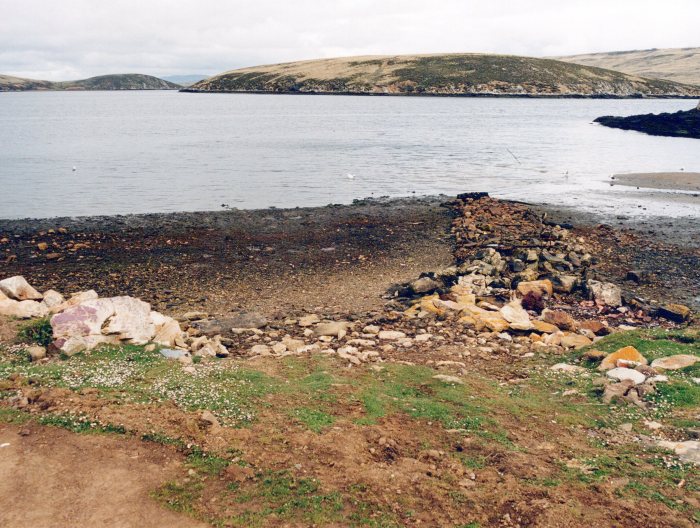
Forward we went into a tunnel of darkness and the unknown. Ten klicks an hour seemed like sixty as we moved up past the sheep sheds and the shadowy outline of Chinook Bravo November was up on our right-hand side. Further on the left, we saw the outline of some cottages and for a brief moment saw a young mother with a baby in her arms staring our of her farm house window. Up ahead was another green light blinking in the three short one long pattern that said we are friendly and so we moved forward. As we approached the light, we made out the shape of a Marine who gave us the cut engines signal. Engines off, out I jump and a give the marine a bright, cheery and incredibly nervous “hello” and met the Royal Marine beachhead officer who asked, “Who are you?” And he was amazed to find the RAF Regiment had landed and we had an entire SAM squadron and all its vehicles to bring ashore. “You better park them there,” he said pointing to the edge of the green that was now serving as the beachhead helipad.
We secured the vehicles, grabbed our weapons and webbing and legged it back to the beach to wait for the next LCL. Passing the farmhouse the young housewife, with her child still in her arms came out with a teapot and some milk. Her first question was who are you? Even with a house full of Para’s she was just checking we weren’t the enemy. Ian said “I’m Ian and this is David” and the immediate relief on her face was quickly followed by the offer of a cuppa. Mugs at the ready we filled our mugs and moved to the beach, and ten minutes later another fire unit and radar came ashore, and we hopped a lift back to the ship to get the next vehicles ready.
More LCL’s and a Mexifloat, a sort of floating dock with a couple of outboard motors on it, were brought in to help unload the ship. It is a slow vehicle-by-vehicle process and with an air raid imminent at any time the ship could be off to safer waters at any time.
My next trip to the beachhead saw dawn finally break and the Marines and Para’s emerging from their trenches on the high ground around San Carlos. With three full fire units ashore we hit our first snag. The rest of our squadron were still at sea and were a day or so away. So Ian (our Chief Tech) made the decision to be ready to deploy at least one fire unit on the helipad if needed.
As the morning progressed, the first fire unit was ready to be deployed when an RAF Regt liaison officer from HMS Fearless arrived to tell us to get ready to strip our fire units and Blindfire radars as they were wanted for spare parts. This was probably the worst order you would want to receive. It was like asking the artillery to spike their guns, or a naval Captain to sink his ship. Sometimes these things are necessary, but I had not spent weeks at sea preparing our fire units for action only to be ordered to Christmas tree them.
Thinking on my feet and with no communication with my boss I politely, well as politely as a corporal can tell a senior officer to go away and reproduce, that it would be better if our fire units replaced any defective ones in the field. To be fair having just been told by a stroppy corporal to get fucked, he took the suggestion on board and went back to Fearless. Meanwhile, we continued unloading at best possible speed.
As the day progressed we realised just how vulnerable we and our equipment was. One decently placed bomb would wipe out all the equipment, but for the three brigade guys in San Carlos they were just chuffed the kit was here.
We worked all through the day and night and eventually the “Causeway five” ended up ashore in San Carlos. We hijacked the LAD (a light aid detachment vehicle. A 4-ton truck used by the motor repair team to repair or tow broken down vehicles) which had two sets of bunk beds in and prepared our first meal ashore of chicken in brown sauce.
Our favourite RAF Regt liaison officer from Fearless arrived with the good news that we did not have to Christmas tree our fire units even though the other batteries were on their knees. Apparently, their engineering support had been left behind in Ascension to make space for more fire units. That is a bit like Ferrari leaving their pit crew behind to have an extra racing car, but one of a few wrong calls that were way above my pay grade. The other good news was that our squadron would begin arriving the next day and would be immediately flown out to replace army fire units that needed to be repaired and redeployed to support of the task force moving forward. We soon got our first sleep in forty odd hours and our last for another thirty or so.
An hour before dawn we stood to and waited, but again the air raid didn’t come. You just can’t know how lucky we were. One bomb would have changed everything. Stand-to over, we made breakfast of bacon grill and compo sausages and beans. The extra pallet of rations acquired on board the ship was a luxury that would prove its worth over the coming weeks.
The first task after breakfast was putting the right vehicles with the right fire units and getting water, fuel and rations and ammunition into each of the support trailers ready for the heli-lift.
Around 10.00 we saw this long tail of forty or so troops emerging up from the beach in full combat order. It was such an impressive sight to finally see the guys start to arrive in full tactical order. Greetings over we briefed the A flight bosses about what was to happen and told them their fire units were good to go and he could be ready to fire twenty minutes after landing.
As the day progressed more of the squadron personnel arrived and finally the boss with HQ, and our Engineering boss came. Handovers completed I teamed up with Paul, my number two, to find our FART (Forward Area Response Team) vehicle as we will be mobile as soon as the fire units go. And still no air raid.
Our Squadron Warrant Officer sought out the “Causeway Five” to tell us he had collected two rounds of ammunition from each man for us. You should have seen the look on his face when we lifted the canvas on the rear of his HQ truck and showed him about two hundred thousand rounds of assorted ammunition and enough rations to run Little Chef for a week. No wonder the lorry was slowly sinking to its axles!
The Boss, being one of the tail-enders to arrive, had a bit of a strop on that equipment and troops were moving and that he had not been briefed. So he took control, and we began organising the area as per his instructions. Our Fearless liaison officer arrived and had an O group with the boss and then the other seniors. Then orders given, the helipad comes to life as Sea King after Sea King, Junglies (commando) and Pingers (Navy anti-submarine) came in and began lifting men, and machines off to the various firebases around San Carlos. Amazing what the offer of a bacon sandwich can do.
With the fire units deployed engineering gets ready and starts working on fixing Army black boxes that are already arriving and will be needed to support their onward move.
The four FART teams are briefed on the site deployments, and we begin the long trek to visit each of our allocated sites to ensure everything is running at one hundred percent. And we are close at hand to fix problems as they arise.
Operational day one over and still no Air Raids – We were so lucky.

Port San Carlos 3 June 1982 (another longish read)
I didn’t get to write up the last few days until today. I am lying on a stretcher during an air raid at the casualty station at Ajax Bay, or the Red & Green Life Machine as they have called it. Casualty 252, nothing serious, but I will get to that.
With the squadron now deployed and operational, engineering wise it is business as usual. More akin to being deployed with the Harrier force in Germany. Well except for the air raids and taking cover in the tent in a pit. Yes, our Black Eagle air raid shelter was a big hole dug in the side of a hill and a tent put up in the hole, needless to say it filled us full of confidence.
Vehicle movement around Port San Carlos was banned, too many drivers were getting bogged-in in the wet peat. We have swopped out land rovers for walking to sites close by, or HQ blagging lifts on helicopters where we can.
The first line engineers operated as 4 teams of two and the genie techs and electrician working wherever they were needed to keep the fire units operational.
First assignment and we (Paul, my oppo, and I) were lucky enough to get a Wessex to our first site. Somewhere in exiting the Wessex with our kit, tools and equipment I managed to cut my arm. T’s and A’s went ok, but there was a problem with the siting of the fire unit. The minimum elevation to fire was too high which meant enemy aircraft coming over Sussex Mountain could get under the missile coverage. Something to feedback when we get back.
Clear of that site we trek to our next one and again do t’s and a’s that went ok, but light is starting to go, and we went weapons free. That basically means there are enemy aircraft in the area and sites are free to engage. It also means friendly helicopters go to ground and we stay overnight at the site where chicken and brown sauce is becoming the staple diet.
A quick listen to the BBC World Service told us that the 5,000 British troops of 5th Infantry Brigade were now ashore, and we had a new commander, Major General Jeremy Moore RM who was now planning for the assault on Stanley.
The marines located nearby were well chuffed that the day before the Marines had defeated an Argentine Special Force patrol at Top Malo House and they had also taken Mount Challenger.
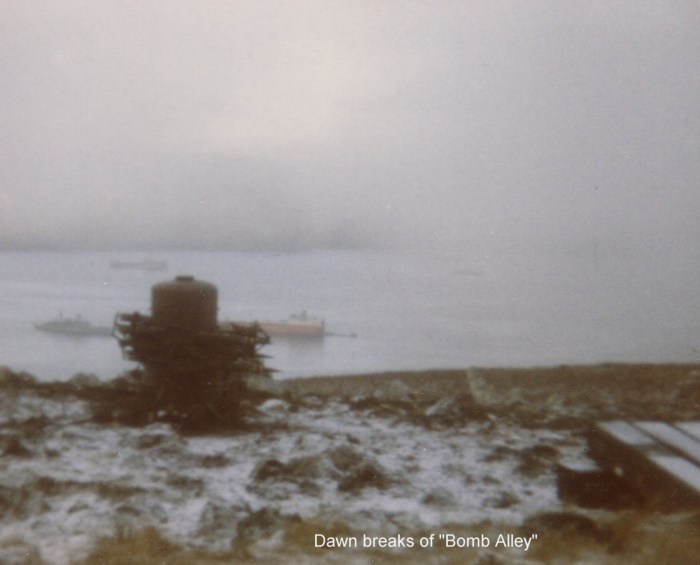
The next morning, it is cloudy over bomb alley and there are no rides until late morning because cloud also means no air raids. When we get back to base we were assigned another site that this time is a trek towards Fanning Head. We spent most of the day there doing t’s and a’s and fixing the TV, that was playing up [2020: note: that is a TV used in aircraft tracking, not a regular TV]
That evening we are back at Black Eagle and catch up with the news and our bosses, (engineering boss, not officer boss) polite request to fill out job cards for anything we do engineering wise. Rapier management in the UK want an accurate record keeping. We also get briefed that our second line engineering team are supporting our squadron and T Battery who left their second line behind in Ascension [2020 note: apparently that is their order of battle]. Two REME techs were assigned to us to work on the optics and hydraulics. Second line was running a 24/7 operation and the challenge that was emerging was avoiding the Squadron Warrant Officers work party. One guy took to sleeping under one of the Houchin generators to avoid him.
This morning started out like most others, ablutions, tea, breakfast, kit check and get assigned quickly to avoid the Warrant Officers work party. Unfortunately, Paul and I got collared for the work party and ended up digging trenches again. That’s when I noticed my right arm was swelling around where it got cut two days ago. Our Warrant Officer spotted the swollen arm. Between him organising a trip to Ajax Bay and the helicopter arriving I had a golf ball lump under my right arm.
The Red & Green Life Machine
I got dropped off with my kit and weapon at the helipad and went to the casualty reception. It sounds grand, but it was a medical orderly, a clip board and not much else. Unit he asks and I tell him, and the banter begins. It starts out with a sorry didn’t know we had royalty here. Our apologies, but first class is not available today…. You know the sort of stuff.
Anyway, I get to see the doc and I am on a gurney and he is having a look at my arm. To my left a marine is having his foot amputated. According to the orderly the marine had said when told his foot was to be amputated, he said “brilliant, I have always wanted to play Long John Silver in panto. Thinking that might be a bit gruesome for me he changes the topic to have a look up there, thats where the Argie bomb is and there is another one over there. It Is dark and you can only see via the reflected light the medics are using. That actually makes the bomb silhouette a little more sinister. I don’t really remember much after that as the doc gave me something to put me out while he fished around in my cut.
Are you OK? Was what I heard as I came out of the anaesthetic. As I opened my eyes there was a priest kneeling over me wearing his stole. I have to say my first reaction was, OMG he is giving me the last rites. However, as my head cleared, the panic receded as he was actually saying do you want something to eat.
I went to get up, but the para on the stretcher beside me said stay put there is an air raid on, so I stayed. A minute or so later the priest returns with steak pie, veggies, gravy and ice cream and tinned fruit. Amazing.
Two hours later the doc checks me out and I can go back to work. I had blood poisoning from the cut. If the warrant officer had not acted when he did, it could have been a very different story.
I went to blag a ride back to Black Eagle and got back in time to kit up and go to another site.
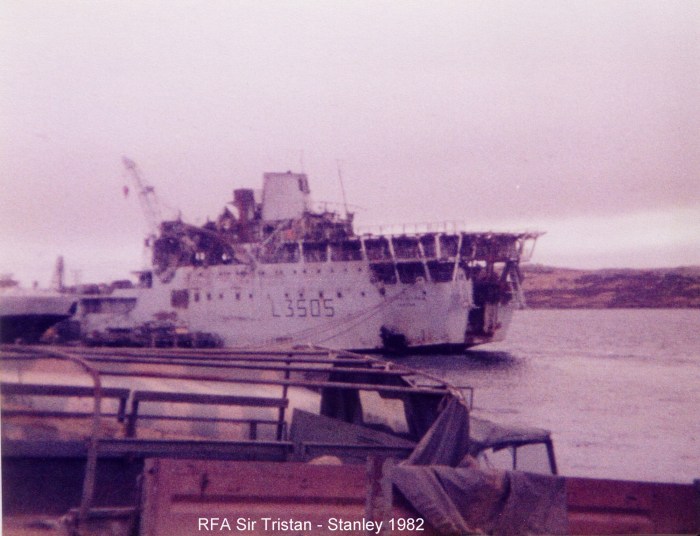
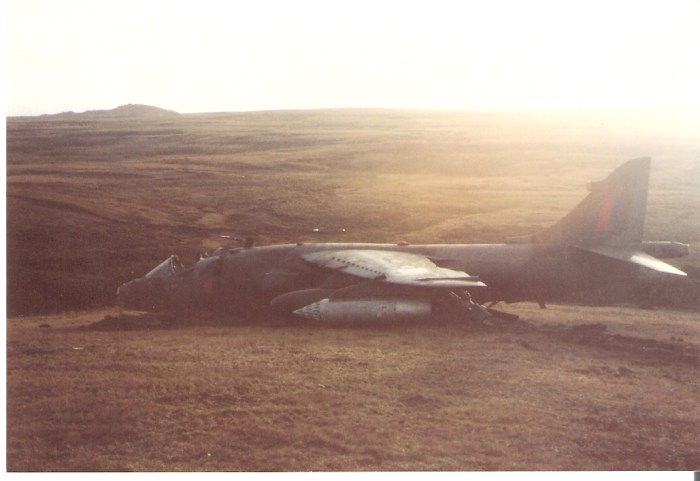
No heli tasking available at the moment, then over the net we get a message from HQ signaller Steve Scott “All Callsigns standby for long message” followed by “Hello all stations this is Zero Bravo, the white flag is flying over Stanley, this does not mean hostility with Argentina have ceased” free to fire. Out.”

 bluebeachmedia
You must be logged in to post a comment.